Modular tooling storage system · Design to end-use product · 3D printed, retail and digital distribution
The ask. Hamilton at CNC With Me had a tooling problem and an audience problem at once. His own collection runs past $2,000 in carbide, stored the way most people store bits — holes drilled in a board, permanently. When a new bit arrives in a different shank size, the board is wrong and there’s nothing to do about it. He wanted a storage system his community could build themselves, and he wanted 3D printed parts integrated into a CNC project, which his audience had been asking for.
The design problem underneath it. Making a bit holder is easy. Making a holder that stays right as a collection changes is not. The requirement was reconfigurability: any clip has to move to any position, repeatedly, without tools and without degrading. It also had to work across shank sizes and across two entirely different enclosures, one wall-mounted and one dropped into a drawer.
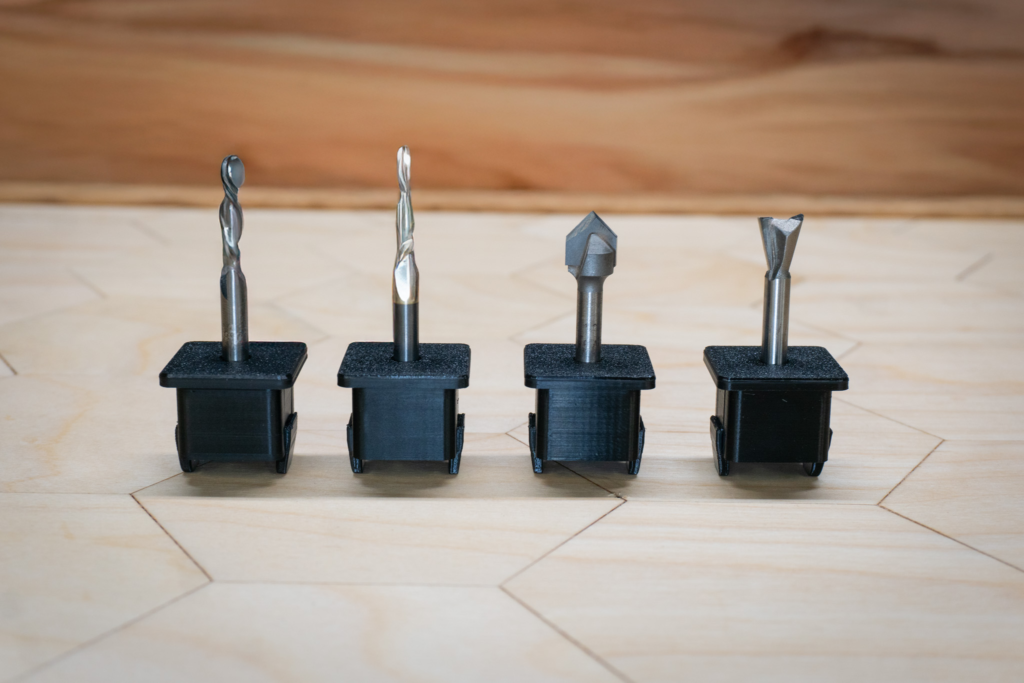
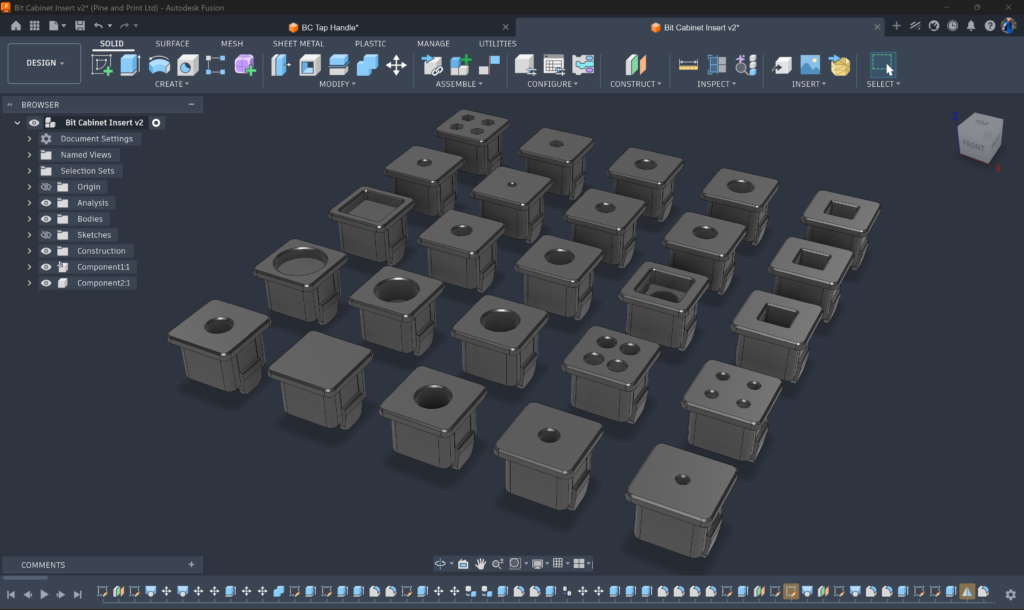
The solution: a spec, not a part. The system is built on a single constraint — half-inch material. Any clip snaps into any half-inch panel, whether that’s plywood, hardwood, MDF, or HDPE. The clip has sprung tabs that click into a cut slot and hold under load; pinch them and the clip releases and moves somewhere else. That happens as many times as the user wants.
Fixing the interface to a material thickness rather than to a specific board is what makes the system open-ended. Slabs come in 8-hole and 10-hole versions, but because the cut pattern is just a repeated SVG, a user can copy it into any panel they design and the clips will fit. The system doesn’t constrain what people build with it — it defines how the parts connect and leaves the rest to them.
Variants. Clips were produced across imperial and metric shank sizes, including 1/8″, 1/4″, and 1/2″. A separate variant accommodates the tubes bits ship in, so the tube slides over the mounted bit and the printed label stays readable while the bit is stored. Tabs on the base of each clip let a loaded slab stand upright on a bench rather than tipping over — a small detail that only surfaces once you’ve carried one to a machine.
Two enclosures, one interface. A wall cabinet assembled from CNC-cut finger joints, and a drawer insert sized to a common rolling tool cabinet. Both accept the same slabs. Slabs lift out of either and carry to the machine, then return to whichever the user prefers. The drawer version exists because a live-stream audience said they store bits in drawers — a mid-project scope change that the modular architecture absorbed without a redesign, since only the enclosure changed and the interface didn’t.
Material spec. Clips print in PETG. The tabs have to flex, hold, and release repeatedly without fatiguing or snapping, which rules out the stiffer, more brittle filaments people default to. That’s the difference between a clip that survives being moved a hundred times and one that breaks the third time.
Shipped two ways. Digital files — CNC files plus STLs — sold through CNC With Me, so the community can cut and print their own. And physical clips produced and sold drectly for people without a printer. One design, two revenue channels, one of them ongoing.
Specs
| System | Modular snap-in clips for 1/2″ panel stock |
| Material | HDPE (printed) |
| Shank sizes | Imperial and metric, incl. 1/8″, 1/4″, 1/2″ |
| Variants | Bare-bit and tube-over configurations |
| Enclosures | CNC finger-jointed wall cabinet; drawer insert |
| Slabs | 8-hole and 10-hole; pattern tileable to any panel |
| Distribution | Digital file pack + physical clips sold direct |
| Design time | 2 Weeks |
Capabilities shown: product system design · design for reproduction · 3D printing · design for assembly · client collaboration · digital product development
 Request a Quote